

One person with a chatbot burns tokens only while typing. One person with 3–20 background bots burns tokens all night. This month sees the start of Grok Bot boom that adds hours of near constant usage. This needs to mostly use ultra low cost and efficient models and harnesses.
Cheap models make it affordable. GLM-5.3-Flash at $0.15/$0.50 per million is ~10x cheaper than a frontier model. $20 per month buys 10x the work. Cheap tokens invite waste. Bots re-reading the same repo, re-planning solved problems, running when nothing changed. Waste doesn’t just cost money — it eats the gigawatts. Caching, sleep-when-idle, and routing the hard 5% to a frontier model are what keep value per token from collapsing.
In July, the top 1% of businesses spent a median $7,400 per employee on AI. The top 10% spent $650. The median firm spent $11.95 per employee.
Here we look at scaling up the token usage and the revenue is a world where most people use overnight agents.
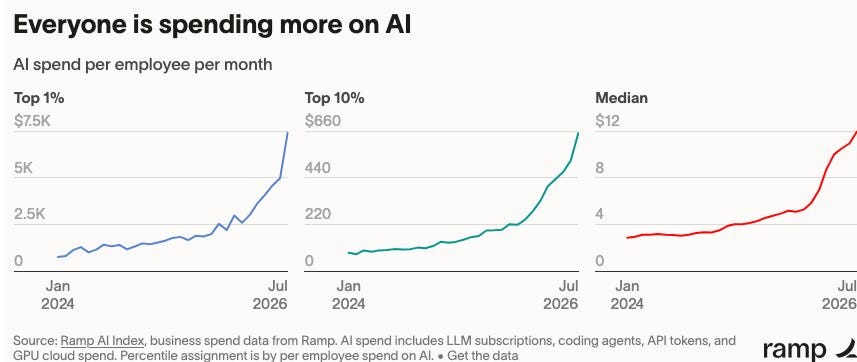

IF Most People Can Become PowerUsers Then Demand Can 200X-400X by 2030
Demand can 200–400X, not 24X by 2030.
Goldman’s forecast is 24X by 2030. That assumes agents stay a feature. If they become the default way work gets done, you get 200–400X instead — which is just 35–40% per quarter, sustained for 18 quarters.


Supply Hinges on More Tokens per Gigawatt or Improved Tokens Per Tasks
Today the industry runs ~25 GW and gets about 17 quadrillion tokens per GW-year. To serve 300X you need 108,000Q/year. Whether that’s possible depends entirely on how fast efficiency improves.
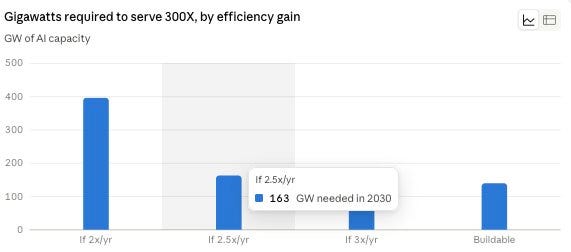
Earth based power additions have limits and ramping delays. 2.7–3x per year in tokens per gigawatt.
