
SpaceX Updates for Faster and Simpler Plan to Return Astronauts to the Moon
by Brian Wang

SpaceX officially detailed progress on the Starship HLS for NASA’s Artemis 3 mission and had a new faster, safer and simpler plan for returning astronauts to the Moon. This responds to the push from NASA and the President for faster lunar landings. SpaceX has completed 49 milestones under the fixed-price Human Landing System (HLS) contract. They have 2026 tests for long-duration flights and in-space propellant transfer.
Since the contract was awarded, SpaceX has consistently been responsive to NASA as requirements for Artemis III have changed and have shared ideas on how to simplify the mission to align with national priorities. SpaceX has shared and is formally assessing a simplified mission architecture and concept of operations that they believe will result in a faster return to the Moon while simultaneously improving crew safety.
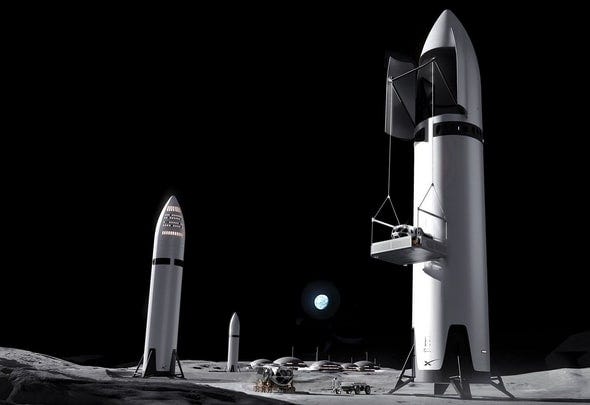
Key elements of the faster/simplified plan
Streamlining operations to reduce complexity, align with updated Artemis III requirements, and enable quicker mission timelines without compromising safety.
Retains Starship’s reusability, 100-ton cargo capacity to the lunar surface, and in-orbit refueling to support sustainable moon presence.


SpaceX is self-funding representing over 90% of system costs for Starship and HLS.
Starship development along two paths:
1. development of the core Starship system and supporting infrastructure, including production facilities, test facilities, and launch sites
2. development of the HLS-specific Starship configuration, which leverages and modifies the core vehicle capability to support NASA’s requirements for landing crew on and returning them from the Moon.
A single Starship has a pressurized habitable volume of more than 600 cubic meters, which is roughly two-thirds the pressurized volume of the entire International Space Station. It has complete cabin that can be scaled for large numbers of explorers and dual airlocks for surface exploration.
Each of Starship’s two airlocks have a habitable volume of approximately 13 cubic meters, which is more than double the space that was available in the Apollo lander.
Cargo variants of the Starship lander will be capable of landing up to 100 metric tons directly on the surface, including large payloads like unpressurized rovers, pressurized rovers, nuclear reactors, and lunar habitats.
SpaceX has already produced more than three dozen Starships and 600 Raptor rocket engines, with more than 226,000 seconds of run time on the Raptor 2 engine and more than 40,000 seconds of run time on the next-generation Raptor 3 engine. There have been 11 Starship-only flight tests and 11 integrated flight tests of Starship and Super Heavy. In parallel, SpaceX has constructed, and continues to construct, new Starship launch, production, integration, and test facilities in Texas, Florida, and California. This private investment of billions of dollars is creating more than five million square feet of manufacturing and integration space, five launch pads across Texas and Florida, and multiple Raptor test stands, all engineered to ramp Starship’s launch cadence above and beyond the paradigm-redefining rate achieved by SpaceX’s Falcon program.
SpaceX’s HLS team has completed 49 milestones tied to developing the subsystems, infrastructure, and operations needed to land astronauts on the Moon. SpaceX has received money only on contractual milestones that have been successfully completed, the vast majority of which have been achieved on time or ahead of schedule.
Highlights of completed milestones include:
* Lunar environmental control and life support and thermal control system demonstrations, using a full-scale cabin module inhabited by multiple people to test the capability to inject oxygen and nitrogen into the cabin environment and accurately manage air distribution and sanitation, along with humidity and thermal control. The test series also measured the acoustic environments inside the cabin
* Docking adapter qualification of the docking system that will link Starship and Orion in space, an androgynous SpaceX docking system capable of serving as the active system or passive system and based on the flight-proven Dragon 2 active docking system
* Landing leg drop test of a full-scale article at flight energies onto simulated lunar regolith to verify system performance and to study foot-to-regolith interaction
* Raptor lunar landing throttle test demonstrating a representative thrust profile that would allow Starship to land on the lunar surface
* Micrometeoroid and orbital debris testing of shielding, insulation, and window panels, analyzing different material stackups that will be used to protect Starship from impact hazards and harsh thermal conditions
* Landing software, sensor, and radar demonstrations testing navigation and sensing hardware and software that will be used by Starship to locate and safely descend to a precise landing site on the Moon
* Software architecture review to define the schematic of major vehicle control processes, what physical computers they will run on, and software functions for critical systems like fault detection, caution and warning alerts, and command and telemetry control
* Raptor cold start demonstrations using both sea-level and vacuum-optimized Raptor engines that are pre-chilled prior to startup to simulate the thermal conditions experienced after an extended time in space
* Integrated lunar mission operations plan review, covering how SpaceX and NASA will conduct integrated operations, develop flight rules and crew procedures, and the high-level mission operation plan
* Depot power module demonstration, testing prototype electrical power generation and distribution systems planned to be used on the propellant depot variant of Starship
* Ground segment and radio frequency (RF) communications demonstration, testing the capability to send and receive RF communications between a flight-equivalent ground station and a flight-equivalent vehicle RF system
* Elevator and airlock demonstration, which was conducted in concert with Axiom to utilize flight-representative pressurized EVA suits, to practice full operation of the crew elevator which will be used to transfer crew and cargo between Starship and the lunar surface
* Medical system demonstration covering the crew medical system on Starship and the telemedicine capability between the ground and crew
* Hardware in the loop testbed activation for the propellant transfer flight test which uses a testbed with flight representative hardware to run simulations for the upcoming propellant transfer flight test
Next Steps
