
Practical Molecular Nanotechnology Tools Proven to Precisely Move Hundreds of Carbon Dimers
By Brian Wang

CBN Nano has built and operated some level of a working prototype system for mechanically controlled mechanosynthesis, even if not every single element of the full envisioned toolset is present in one published figure set. They have done and documented hundreds of carbon dimer pick and place actions. I, Brian Wang, invested as one of the first angel investors in Nanofactory. There is non-public information that I cannot disclose. All of this is public information.
~60–70% of the early molecular manipuulation tool-system requirements described in the roadmap are directly demonstrated or strongly inferred from published papers.
The work excels at the foundational experimental platform (inverted-mode STM + custom molecular tools + zero-bias mechanical reactions) and specific reactions (H-abstraction + activation + C₂ donation).
Key aspects of Picometer-level positional control (STM/SPM-based manipulators) and sensing of position are shown. Custom mechanosynthetic tooltips (minimal toolset - H-abstraction, H-donation, C₂ dimer placement, etc.) are functional.
It is weaker on a fully integrated “workstation” with multiple simultaneous tools, diamond surfaces, and higher-phase features (those remain closer to the theoretical/simulation side of the roadmap or future work).
The fact that they can do reproducible, zero-bias, mechanically driven chemistry with designed molecular tools on atomically prepared sites is exactly the kind of proof-of-concept the Molecular Workstation Roadmap was calling for in its early phases.
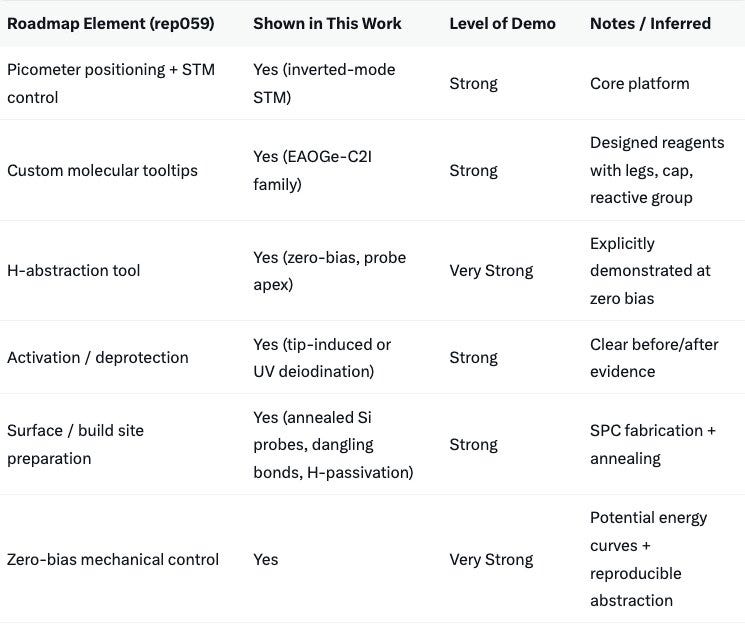
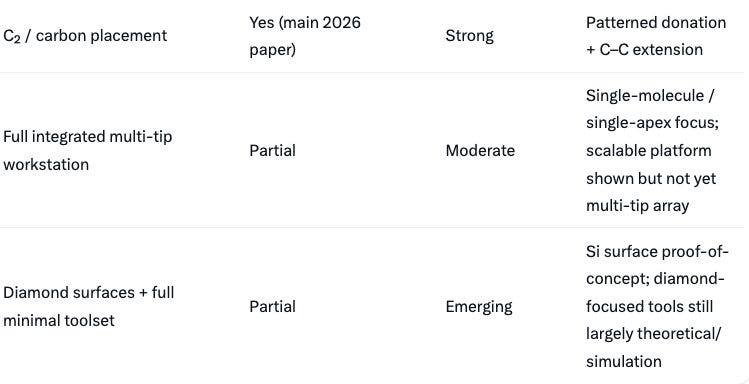
What the Roadmap (rep059) Calls For in a Molecular Workstation Tool System
The report surveys the core technologies required
Picometer-level positional control (STM/SPM-based manipulators).
Custom mechanosynthetic tooltips (minimal toolset - H-abstraction, H-donation, C₂ dimer placement, etc.).
Surface preparation and build sites (passivated or reactive surfaces, dangling bonds).
Zero-bias or mechanically driven reactions (to avoid unwanted electrochemistry or heating).
Molecular tool design (oriented reagents with legs/handles, protective caps, catalytic elements like Ge).
UHV/cryogenic environment + imaging/positioning integration.
Activation/deprotection of tools (e.g., removing caps to expose reactive sites).
Reproducible abstraction/donation on atomically defined sites.
The goal is a controllable workstation platform (starting macroscale/SPM-based) that can perform the foundational DMS reactions reliably.
What Is Actually Shown and Demonstrated in the Published Work
The figures and text Inverted Mode STM paper (plus the main 2605.27250 paper) directly address several of these.


1. Custom Probe Fabrication & Annealing — Strong demonstration
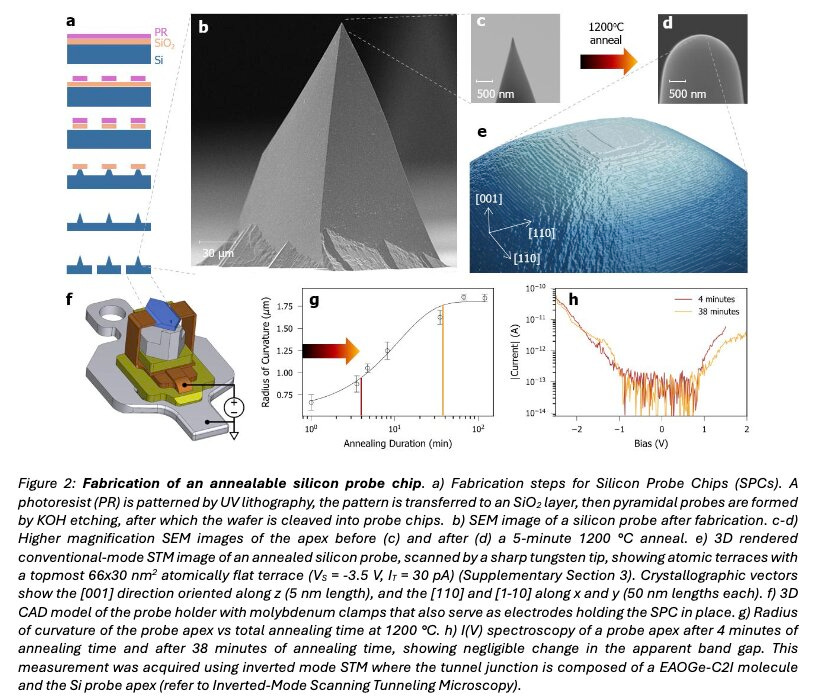
Silicon Probe Chips (SPCs) fabricated via lithography + KOH etching into sharp pyramidal probes.
High-temperature annealing (1200°C) creates atomically flat terraces and clean apices (confirmed by STM imaging before/after).
This is a practical, reproducible way to make high-quality, annealable silicon tips/build sites — directly relevant to creating controlled surfaces and apices for mechanosynthesis.
2. Inverted-Mode STM Platform — Core platform demonstrationMolecules (EAOGe-C2I) are placed on the sample; the silicon probe chip acts as the build site.
The molecule functions dually as imaging probe and mechanosynthetic reagent/tool.
This inverted geometry improves control and allows the molecule to image the apex while reacting with the build site.
Effective RPI (Reactive Probe something — likely molecule-induced imaging features) diameter tracked vs. annealing — shows control over apex quality.
3. Hydrogen Abstraction at Zero Bias — Direct evidence of mechanically controlled chemical reactionProbe apex is hydrogenated.
Molecule on the build site is positioned (x-y alignment via STM, z-control for separation).
At zero bias, hydrogen is reproducibly abstracted from the probe apex to the molecule.
Potential energy curves show the reaction becomes barrierless or very low-barrier at close approach (~100 pm separation).
This is mechanically/positionally driven (force from proximity), not voltage-driven electrochemistry — exactly the kind of controlled mechanosynthesis the roadmap emphasizes.
Inset STM images confirm before/after changes.
4. Tool Activation / Deiodination
Molecules start capped with iodine.
Tip-induced bias ramp (or UV light) removes the iodine cap → exposes the reactive site (C₂ or equivalent).
Height jump (~200 pm) and imaging changes confirm successful deiodination/activation.
This matches the roadmap need for “activation” or deprotection steps in a toolset.
5. Overall Tool Molecule (EAOGe-C2I family)
These are sophisticated, designed molecular tools: legs for upright orientation/anchoring, Ge substitution (likely for catalytic or stability reasons), C₂ group for donation, iodine cap for protection.
They enable both imaging and targeted mechanosynthesis.
The 2026 paper shows these tools successfully donate C₂ and form C–C bonds in patterns — extending the H-abstraction work into carbon placement.
Project Background and Scale From AI Summary of Public Info
Barton joined the stealth startup Nanofactory Inc. in 2009 as the second employee. The effort focused on “direct-to-diamondoid” atomically precise manufacturing using scanning probe methods and custom molecular tools.
It grew into CBN Nano Technologies Inc. (incorporated ~2017), a subsidiary/project of Canadian Bank Note Company (CBN). The goal shifted toward commercial-scale atomically precise manufacturing, initially for advanced security features (fraud-proof documents) with broader applications in quantum computing, medicine, etc.
Major support came from the Canadian government’s Strategic Innovation Fund (SIF) — a $40 million contribution agreement (announced ~2019, Agreement 813022) specifically for this nanotechnology project. Total funding for CBNNT reached ~$30.6M in one report. CBN itself made a large internal R&D investment.
Barton has publicly referred to the team we built over fifteen years. The 2026 paper lists ~40–50 co-authors (many explicitly affiliated with CBNNT), plus acknowledgments of “many other colleagues.” Job creation announcements mentioned hundreds of highly skilled positions tied to the broader project.
Extremely secretive (stealth startup). Barton has said he could not discuss actual results publicly until recently. The focus was on building experimental capabilities in surface science, vacuum technology, and precision instrumentation.
Key areas of progress (inferred from patents, the 2026 paper, Barton’s statements, and related outputs)
Theoretical & Simulation Foundation (ongoing throughout)
Extensive computational work on tooltips, reaction pathways, build sequences, and error analysis (hundreds of thousands of CPU-hours in related efforts by Freitas/Merkle collaborators).
Design of minimal toolsets for DMS.
Updated roadmaps (including rep058, rep059 and rep060 in 2025).
Experimental Infrastructure & Capabilities (core of Barton’s role — he explicitly said his job was “to build the experimental program”)Advanced surface science and vacuum labs (UHV, cryogenic conditions).
Custom inverted-mode STM (scanning tunneling microscopy) systems for high-precision positional control.
Development and synthesis of specialized molecular tools (e.g., Ge-substituted adamantane derivatives with C₂ groups and protective caps) that act as both imaging probes and mechanosynthetic reagents.
Surface preparation techniques (hydrogen-passivated Si(100)) and dangling-bond patterning via bias pulsing.
Integration of theory (simulations) with experiment for mechanistic understanding (QM/MM, DFT validation of reaction pathways).
Core Mechanosynthesis Breakthrough
(culmination of the effort, published 2026)The May 2026 arXiv paper (2605.27250) is the main public deliverable.
Demonstrated controlled, positionally precise C₂ donation (addition of carbon dimers) to specific sites on a silicon surface.
Multi-site patterning and stepwise C–C bond formation to build extended structures (e.g., polyyne-like chains).
High reproducibility (yields 84–97%), low off-target reactions, and simultaneous spatial + chemical control.
Barton has described this as the team successfully validating “diamondoid mechanosynthesis theories” after 15 years — “foundational experimental work that fully validates the theories developed over the past forty years” and a direct realization of Feynman’s vision at the atomic level.
Multiple patents on mechanosynthesis systems, tips, build sequences, mechanical computing, and related methods (many listing Barton, Freitas, Merkle, and CBNNT colleagues as inventors).
Internal development of workflows combining chemistry, surface science, physics, engineering, and simulations.